
Key takeaway
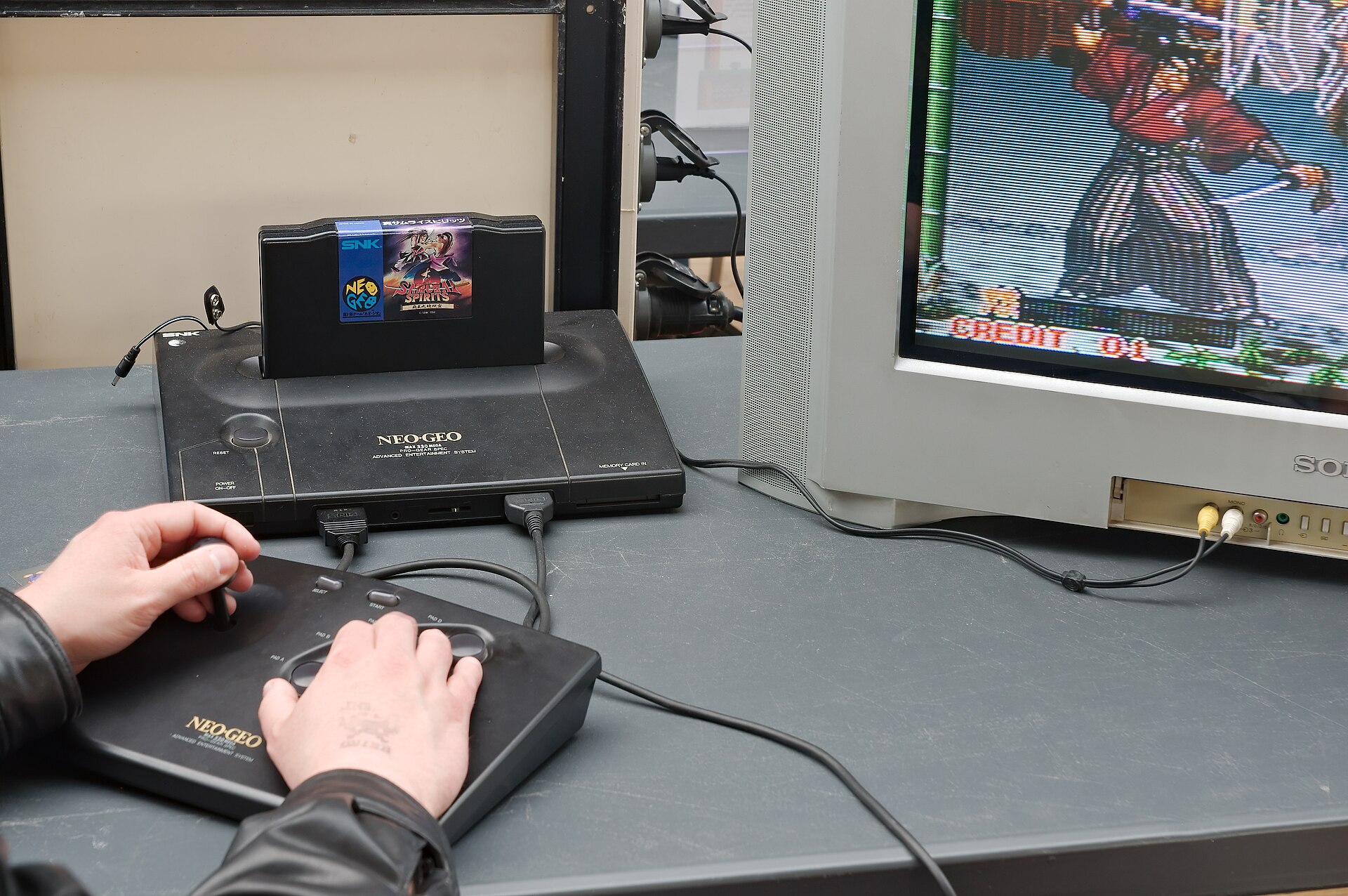
AES is the home-console side of the Neo Geo platform. Sold to the public from 1991, it runs the same underlying game software as MVS while using a different cartridge format.
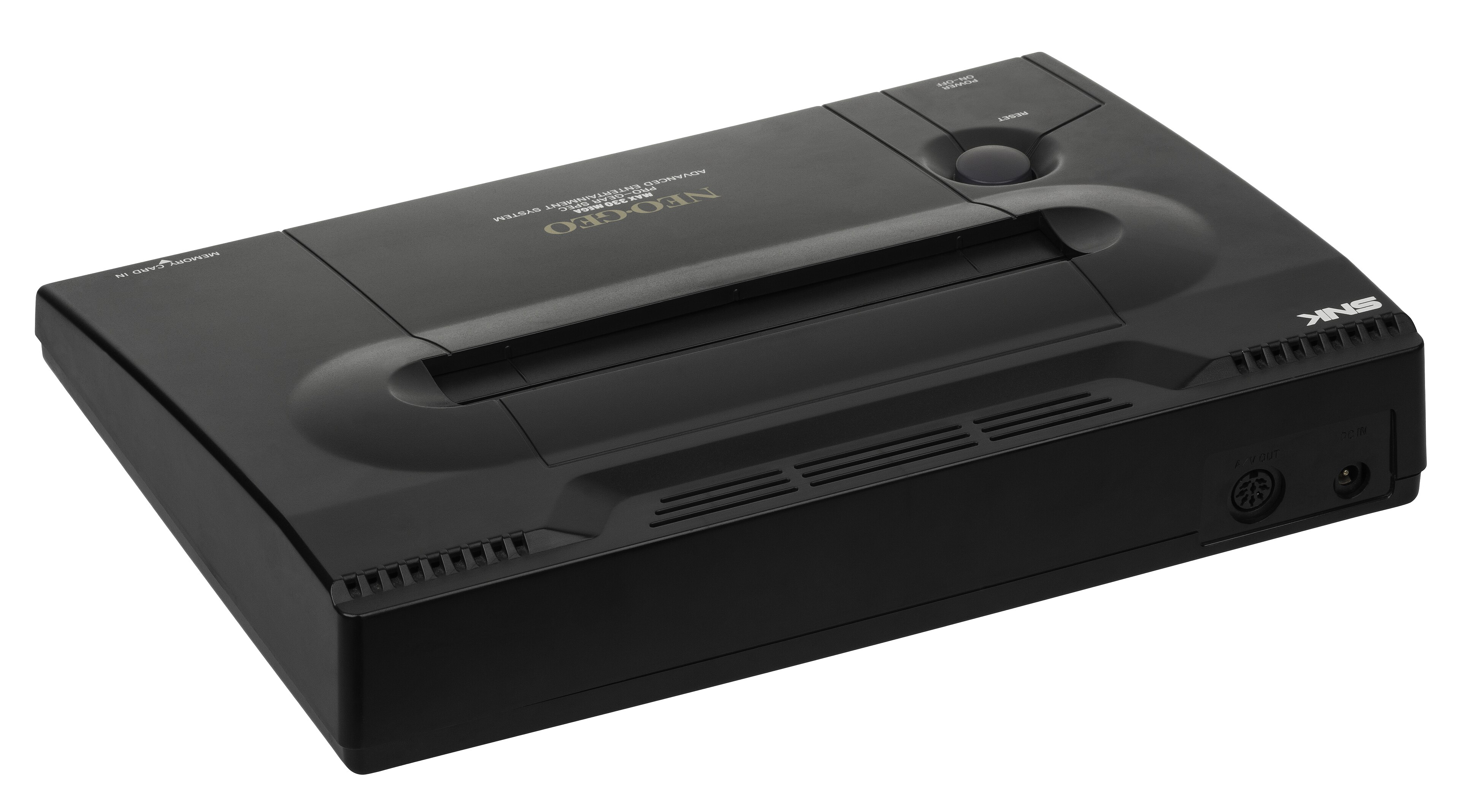
The Neo Geo AES is the home-console side of the Neo Geo platform developed by SNK with Alpha Denshi. Introduced in Japan through a rental scheme in 1990 and sold to the public from 1991, it runs the same underlying game software as the MVS arcade system. Its cartridges are physically different, however, and cannot simply be swapped between the two machines. The point of the AES was unusually direct: bring SNK’s arcade games home without rebuilding them for less capable consumer hardware.
That idea still defines the console’s reputation. It also helps explain the large cartridges, the substantial arcade-style controller and a catalogue shaped by short, demanding play sessions. Yet the actual machine is more interesting than the familiar “luxury console” label suggests. Understanding it means looking at how SNK connected the arcade and the living room, what its hardware was designed to do and what owning three-decade-old equipment now requires.
Short answer: AES stands for Advanced Entertainment System. It is the single-slot home version of the Neo Geo platform. MVS, or Multi Video System, is the arcade version, produced in one-, two-, four- and six-slot configurations. AES and MVS share their core architecture and game data, but use different cartridge shells, connectors and operating modes.
An arcade platform that happened to live at home
Arcade at home
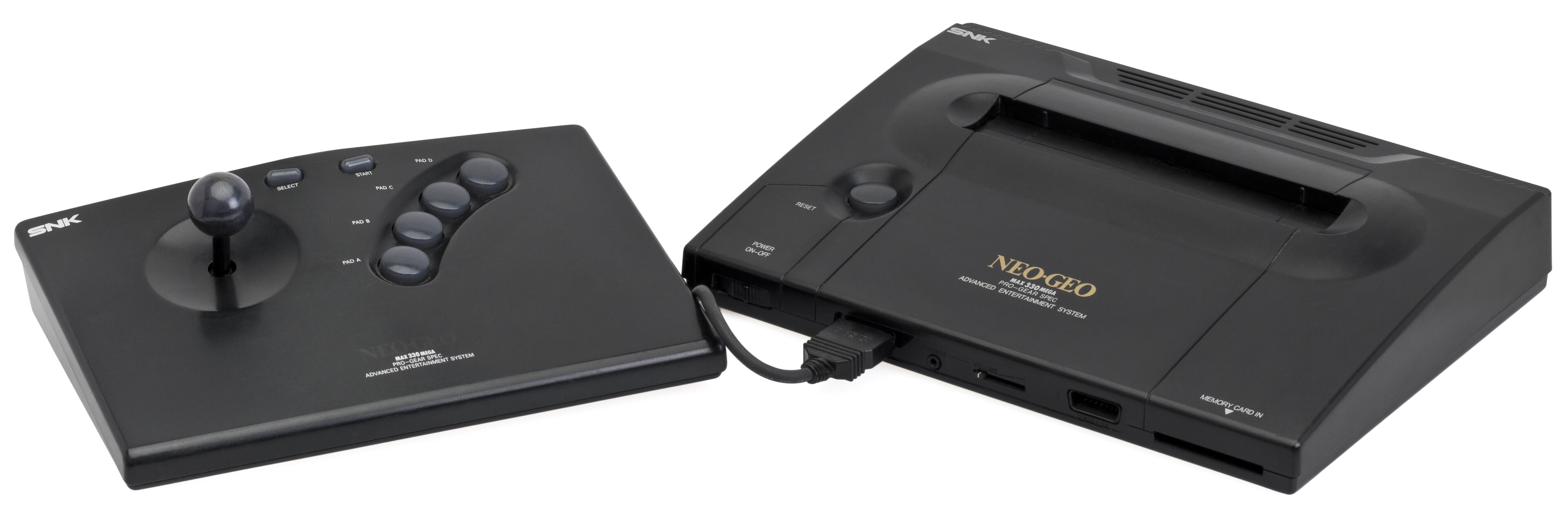
A console designed around its stick
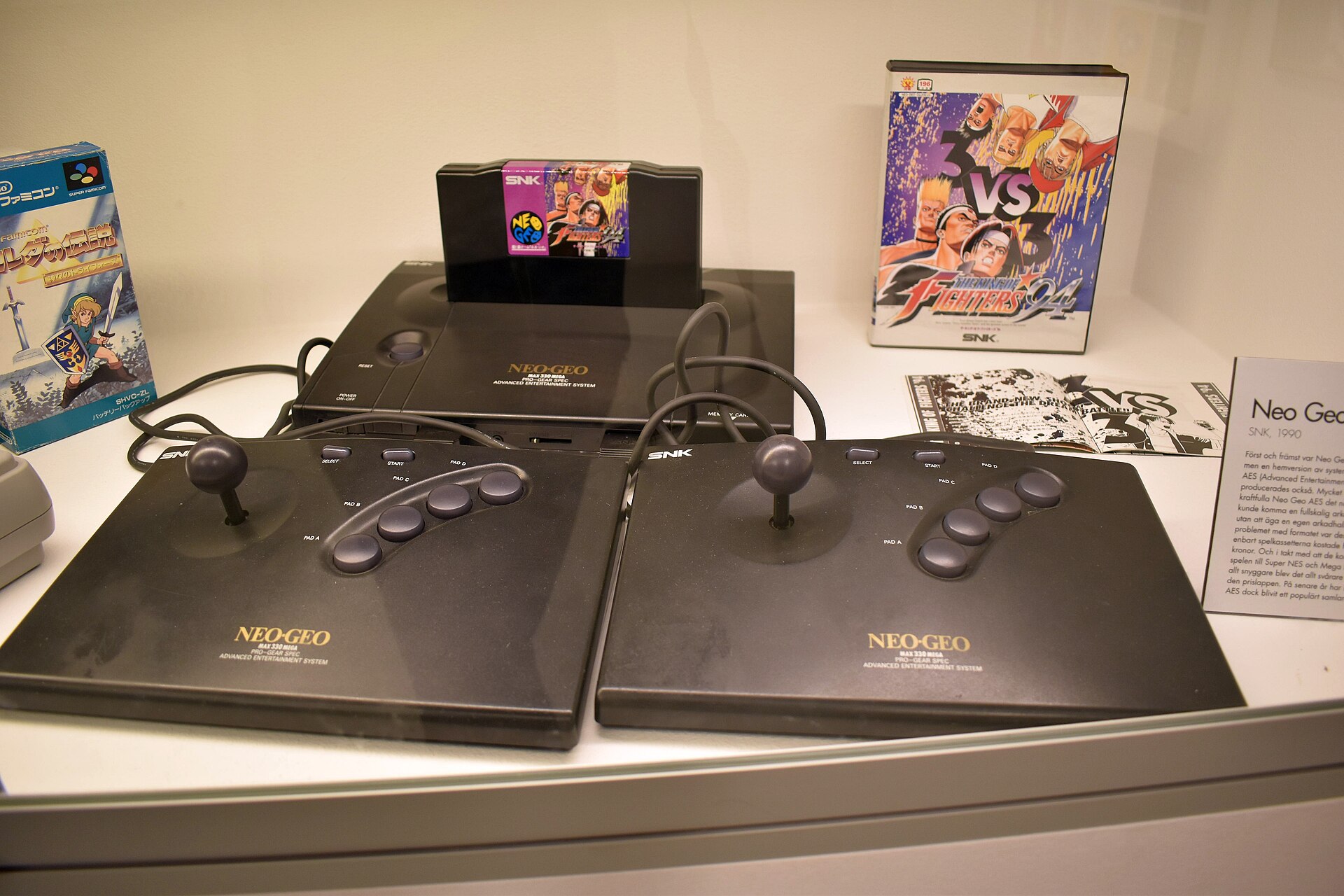
The AES controller follows the logic of an arcade panel. Its microswitched lever and four face buttons were part of SNK’s intended experience, not an accessory added after the fact.
Photo: Evan-Amos — Wikimedia Commons — CC BY-SA 3.0.
At the start of the 1990s, playing an arcade title at home usually meant buying a port. Developers had to reshape the game around a domestic console’s limits: fewer colours, smaller sprites, reduced sound samples, missing animation or redesigned stages. Some conversions were excellent, but they remained conversions.
SNK took another route. Working with Alpha Denshi, later known as ADK, the company created one platform for commercial and domestic use. SNK’s own NEOGEO Museum overview describes MVS and AES as two applications of the same system. An arcade operator could install several games in a compatible multi-slot MVS cabinet, while a home owner used one cartridge at a time in the AES.
SNK’s official company history places the launch of MVS and NEO GEO in April 1990. The home machine did not initially follow the usual retail path. SNK supplied it through a Japanese rental programme based around video shops. Renting the console and its games lowered the first barrier to trying unusually expensive hardware.
Public sales began in 1991. The official NEOGEO title catalogue dates an early group of home cartridges to 1 July 1991, including NAM-1975, Magician Lord, Baseball Stars Professional, Ninja Combat, The Super Spy and Cyber-Lip. Most had already appeared on MVS. Their arcade origin was not disguised; it was the central proposition.
AES and MVS: shared software, different products
Calling the AES “the arcade at home” is fair, provided the phrase is not taken too literally. A Neo Geo game could contain both its arcade and home behaviour. The system BIOS told the software whether it was running on MVS or AES, as well as the selected region. The game could then change its rules and presentation.
At home, a title might offer limited credits, selectable difficulty or options that do not make sense in a coin-operated cabinet. MVS has to manage credits, operator settings and, on multi-slot boards, game selection. SNK’s 1991 hardware specification manual also asks developers to consider longer demonstrations and features suited to home use rather than simply reproducing a paid arcade session.
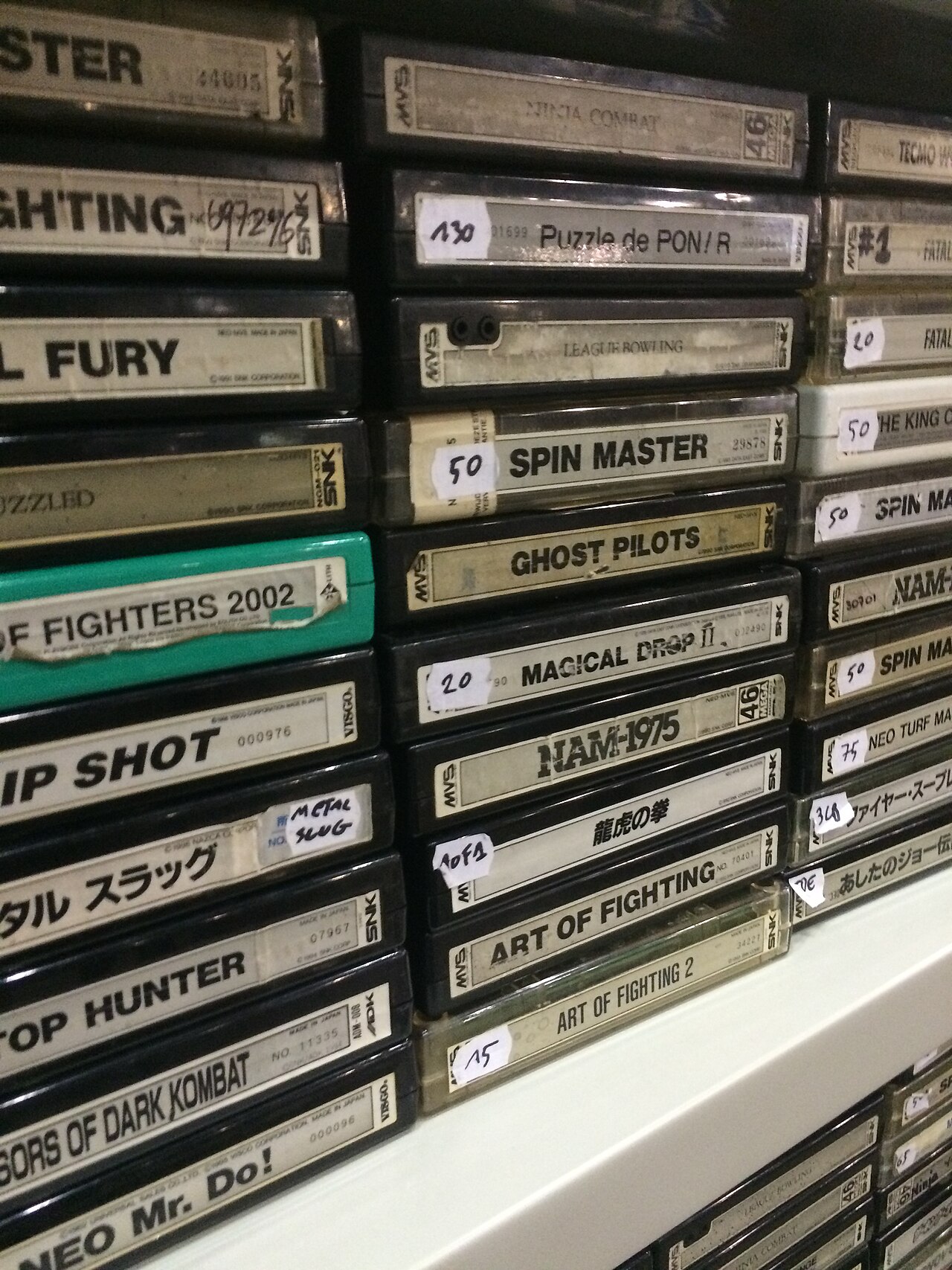
The cartridges are not physically interchangeable. AES and MVS releases use different shells, connectors and pin arrangements. Adaptors and conversions exist, but they are additional hardware or altered products; they do not make the original formats identical. That distinction matters when buying, collecting or authenticating a game.
| Feature | Neo Geo AES | Neo Geo MVS |
|---|---|---|
| Original setting | Home rental, then consumer sale | Arcade and commercial operation |
| Game slots | One | One, two, four or six, depending on board |
| Cartridge | AES shell and connector | MVS shell and connector |
| Operating mode | Home behaviour selected by BIOS | Coin, credit and operator behaviour |
| Save system | Front memory-card slot | Memory card on equipped boards or cabinets |
| Controls | Two controller ports | Cabinet wiring; ports on some boards |
The achievement was still considerable. SNK did not need to rebuild a substantially reduced version of each game for the home machine. But shared software does not mean shared cartridges, identical settings or an identical social experience.
Neo Geo AES hardware specifications
The values below are drawn from SNK’s 1991 development documentation and the scanned NEO-AEC consumer manual. They describe the reference architecture. Power requirements, internal board revisions and video quality vary across individual AES units.
| Component | Documented specification |
|---|---|
| Main processor | HD68HC000 / Motorola 68000 family at 12 MHz |
| Sound processor | Z80A at 4 MHz |
| Work RAM | 64 KiB |
| Video memory | 64 KiB plus 4 KiB in the developer manual; 68 KiB in the consumer manual |
| Working display | Up to 320 × 224 pixels; 288 × 208 safe area recommended |
| Colour | 4,096 simultaneous colours from a palette of 65,536 |
| Graphics | Up to 380 line sprites, with 96 on one horizontal line |
| Sound | Yamaha YM2610 providing FM, PSG and ADPCM, managed by the Z80A |
| Documented outputs | Composite A/V, RGB depending on cable and model, stereo headphones |
| Controls | Two ports; four-button stick with Start and Select |
| Storage | Removable JEIDA-format memory-card slot |
| NEO-AEC dimensions | 325 × 237 × 60 mm |
A graphics system built around sprites
The Neo Geo does not construct its picture like a typical home console with several conventional scrolling background layers. Much of the image is assembled from vertical strips known as line sprites. Each can join 32 tiles measuring 16 × 16 pixels into a strip as large as 16 × 512 pixels. Developers chain, move, flip and shrink these elements to build characters as well as scenery.
This arrangement helps explain the large fighters, elaborate animation and zoom effects associated with SNK games. It also has clear limits. The documentation permits 96 line sprites across one horizontal scanline; lower-priority elements may disappear when a scene exceeds that load. Late games could push hardware defined at the beginning of the decade hard enough to produce visible slowdown or missing elements.
The often-quoted 4,096-colour figure is a simultaneous maximum selected from 65,536 possible colours. It does not mean that every scene automatically uses the full count. The artists’ palette choices, animation and drawing remain more important than the headline number alone.
Sound with an arcade character
The Yamaha YM2610 combines FM synthesis, a programmable sound generator and ADPCM sample playback. A Z80A manages the audio subsystem. This gave composers access to sharply defined melodic parts, sampled percussion and speech that sounded extravagant on an early-1990s home system. A front-mounted stereo headphone socket with its own volume control made those capabilities practical in a domestic room.
The controller was part of the design
The original stick is roughly 28 centimetres wide. Its microswitched lever and four coloured face buttons echo a cabinet control panel, supplemented by Start and Select. This is more than themed packaging: fighting-game motions, rapid direction changes and button combinations were designed around arcade controls.
The consistency has practical consequences. A complete AES setup needs space, and a two-player session requires two sizeable controllers. A stick should sit firmly, its cable should not pull against the console and all directions and buttons should be tested before purchase.
The memory card linked arcade and home
Arcade and home
A save file you could carry
The memory card was designed to hold progress or scores between a compatible cabinet and the home console. Its capacity is tiny by current standards, but continuity between two locations was unusual in 1990.
Photo: Evan-Amos — Wikimedia Commons — CC BY-SA 3.0.
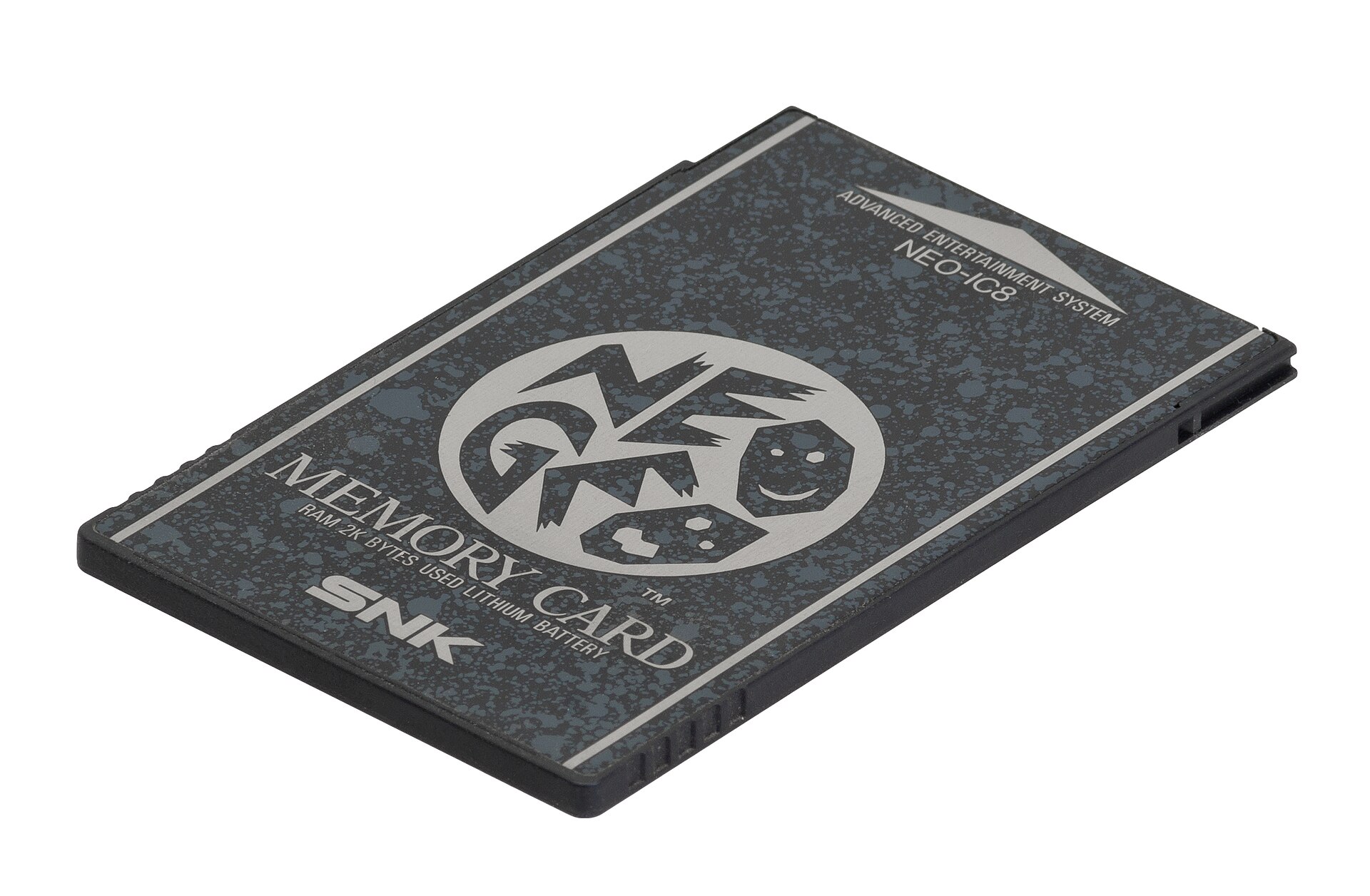
One of the Neo Geo’s most forward-looking features was its removable memory card. SNK intended players to save progress or scores on a supported MVS cabinet, carry the card home and continue on AES. The route could also work in reverse.
The developer manual tells studios that a card must remain optional for play and describes page-based saving and loading. Hardware analysis in the NeoGeo Development Wiki identifies the original card as 2 KiB of battery-backed SRAM. That sounds tiny now, but games needed to retain only small amounts of information, such as a stage, player state or score.
An original card can be complete and attractive while no longer storing data reliably because its battery has aged. Collecting and everyday use are therefore different questions. A modern compatible card may be more dependable for regular play, whereas repairing an old one should be done with a clear understanding of what is being replaced.
A catalogue shaped by changing arcades
Did you know?
“100 Mega Shock” was not a hardware generation
The slogan identified games that passed 100 megabits of ROM data. SNK’s museum names Art of Fighting as the first Neo Geo title to cross that threshold.
Photo: Evan-Amos — Wikimedia Commons — public domain.
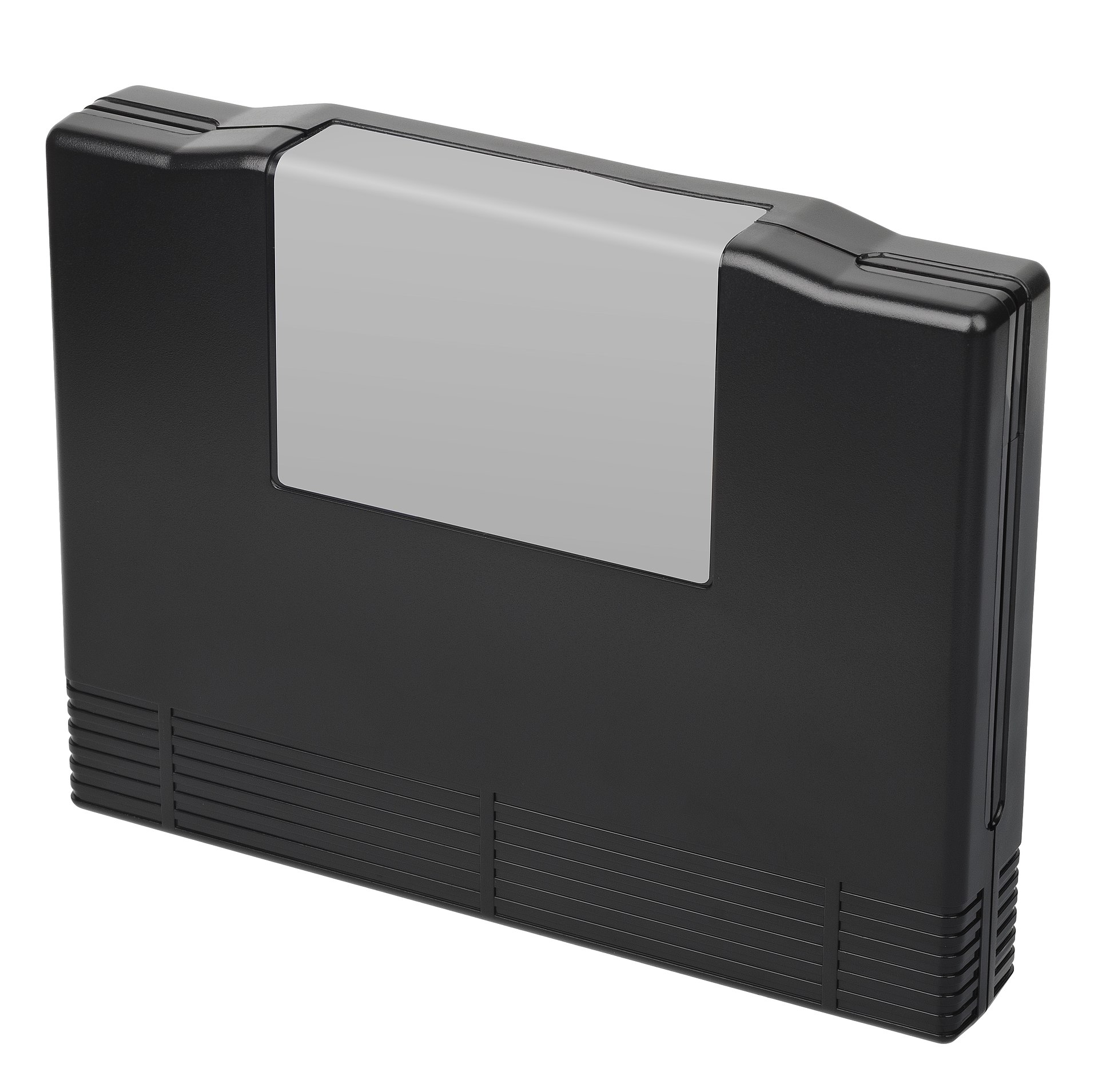
Hardware and game
Putting colour back into the Neo Geo story
A game cover is not automatically free to reuse. The photographs below remain in their documented context: one is in the public domain and the other is available under a Creative Commons licence.
The Neo Geo did not begin as a fighting-game-only platform. Its 1990 and 1991 line-up covered action, shooting, sport, racing, puzzles, quizzes and mah-jong. Magician Lord, NAM-1975, Last Resort, Baseball Stars Professional and League Bowling reflect a general-purpose arcade system trying to serve different locations and players.
One-on-one fighting soon transformed its identity. Fatal Fury reached MVS in November 1991 and the home format in December. Art of Fighting followed in 1992 and, according to SNK’s museum, introduced the “100 Mega Shock” label by passing 100 megabits of ROM data. Capacity is not a direct measure of quality, but it gave teams more room for artwork, sampled voices and animation.
Samurai Shodown brought weapon combat in 1993, while Fatal Fury Special refined the competitive structure. The King of Fighters ’94 then joined characters from several SNK properties in team battles. Its annual sequels became a spine for the platform well into the following decade.
The later catalogue demonstrates a broader range than that reputation suggests:
- Neo Turf Masters turns golf into an immediately readable arcade competition;
- Metal Slug combines precise run-and-gun action with expressive hand-drawn animation;
- Twinkle Star Sprites makes a competitive duel from a scrolling shooter;
- Pulstar and Blazing Star take different approaches to the horizontal shoot ’em up;
- Windjammers builds a fictional sport around angles, positioning and fast reactions;
- The Last Blade series offers a different pace and mood from Samurai Shodown;
- Garou: Mark of the Wolves and Metal Slug 3 show what experienced teams could extract from ageing hardware around 1999–2000.
This is not a definitive ranking. It is a way to identify what the system does well. Someone discovering Neo Geo does not need to begin by pursuing the rarest AES cartridge. Genre, intended use and a legal, affordable way to play matter more than prestige.
Fourteen years of official releases, with context
SNK’s historical timeline describes Neo Geo as receiving new software over fourteen years. After the former SNK closed in 2001, Playmore acquired its intellectual properties and releases continued. SNK’s official series page dates Samurai Shodown V Special to 22 April 2004 on MVS and 15 July 2004 on the home cartridge format. It is the final home release in the company’s historical catalogue.
Calling it the last official cartridge refers to that original commercial cycle. Independent games and later projects have since appeared for the hardware. They require their own checks for publisher, licence, manufacturing quality and compatibility rather than being folded into the historical catalogue without explanation.
Buying an original Neo Geo AES: what to verify

An AES should not be bought from a single photograph of its top shell. The market combines old electronics, imports, repairs, modifications, authentic cartridges, conversions and reproductions. A useful listing should let the buyer understand precisely what is included and what has been tested.
1. Decide whether the goal is play or collection
Three projects can look similar in a photograph:
- playing on original domestic Neo Geo hardware;
- collecting authentic, complete AES editions;
- discovering Neo Geo games through another official release or system.
The AES suits the first two, with different levels of scrutiny. It is not always the simplest route to the third. Consolised MVS hardware, Neo Geo CD and authorised digital editions answer different needs, though none is the same physical object or reproduces every aspect of AES ownership.
2. Request useful evidence
Ask for clear images of the console’s top and underside, label and serial, cartridge slot, connectors, supplied power unit, controller, video cable and a game running. If the unit has been modified, ask who performed the work, when it was done and whether there is documentation.
A serial number alone cannot identify the motherboard with certainty. The AES hardware reference documents revisions from NEO-AES to NEO-AES4-1. Confirming the board requires an internal inspection carried out without damaging the shell or components.
3. Never guess the power supply
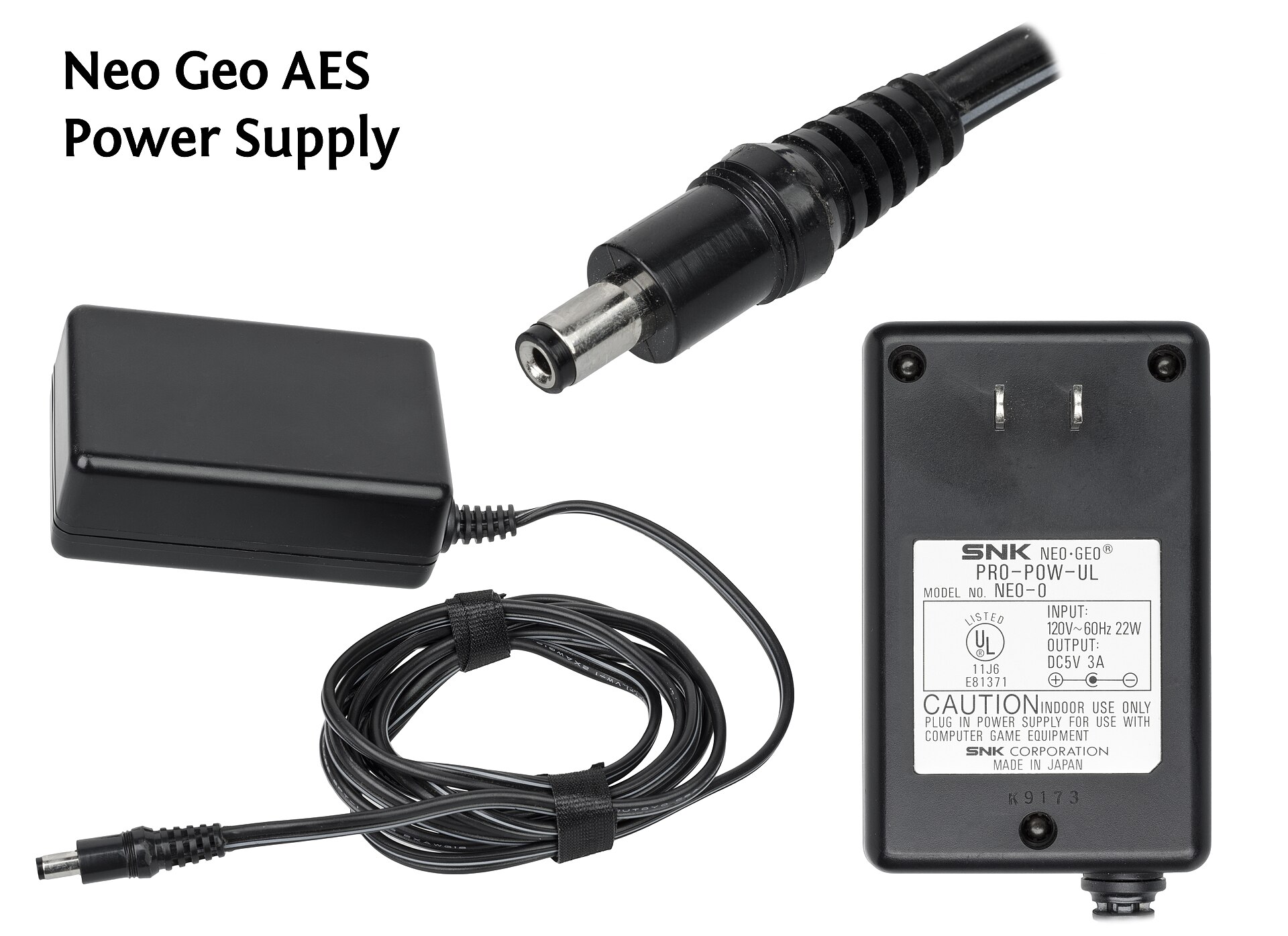
This is the main safety check. Not every AES expects the same input. Some PRO-POW-family units supply regulated 5 V, while NEO-POW3 models supply about 10 or 11 V. Connector polarity matters too. The Neo Geo power-supply reference warns that applying 10/11 V to an early 5 V console can damage it.
Read the label under the console and match the required voltage and polarity. Then make sure the power unit itself is designed for the mains voltage used in your country. A plug-shape adaptor does not convert voltage. If the label is missing, unclear or inconsistent with the internals, have the machine inspected before switching it on.
4. Plan for an analogue video signal
The AES was designed for analogue televisions. Depending on the revision and cable, it can provide composite video and RGB, with notable differences in output quality between boards. A modern display may reject these signals or process them with scaling, smoothing and delay that work poorly for arcade games.
The appropriate setup may be a compatible CRT, a correctly wired RGB connection or a scaler designed for the low-resolution signals of older consoles. A connector fitting the socket does not prove that its pinout, signal levels and destination display are compatible.
5. Treat authenticity and operation as separate tests
A cartridge can run without being an original AES release. MVS-to-AES conversions, reproductions and counterfeit products circulate. The Neo Geo bootleg reference explains why an exterior inspection may be insufficient and why photographs of both internal PCBs can matter.
For a high-value item, request its history, exact box contents, proof of operation and clear board photographs where appropriate. A knowledgeable reviewer can compare PCB and ROM references with known examples. Opening a cartridge without the right method can break clips or damage its label, so authentication also carries a cost and risk.
6. Test the stick, cartridge slot and storage conditions
Every direction, face button, Start and Select should respond consistently. The console should boot without the cartridge being forced or twisted. Cleaning dirty contacts requires suitable materials and a dry, controlled process; harsh abrasives or fluid left inside can create a worse fault.
The NEO-AEC manual specifies operation from 5 to 35°C and 20 to 80 per cent humidity. Store the console away from condensation, damp walls, direct heat and trapped moisture. In humid climates, ventilation and regular inspection matter more than sealing warm hardware in plastic. Any desiccant should be monitored and replaced rather than forgotten inside a closed box.
Original Neo Geo AES or NEOGEO AES+?
Search results in 2026 often mix the historical AES with the announced NEOGEO AES+. They are different products. Plaion Replai’s official page presents AES+ as a modern SNK-licensed implementation scheduled for release on 12 November 2026, with compatibility for old and new cartridges and HDMI output.
An original AES is 1990s hardware with period circuit boards, analogue outputs and revision-dependent power requirements. AES+ is intended as a contemporary machine built around the historical cartridge format. Until the retail hardware is released and independently tested, complete compatibility, display latency and final performance should be reported as announced specifications rather than measured results.
| Question | Original AES | Announced NEOGEO AES+ |
|---|---|---|
| Era | Hardware made in the 1990s | Launch announced for 2026 |
| Design | Historical SNK chips and boards | Modern licensed implementation |
| Video | Analogue, dependent on revision | HDMI and A/V announced |
| Cartridges | Historical AES releases | Old and new cartridge support announced |
| Buying condition | Used; revision and servicing need checks | New and in pre-order during research |
Why the Neo Geo AES still matters
The AES cannot be judged only by the number of homes it reached. SNK followed its technical promise further than most domestic systems of the period: software designed for an arcade board could operate at home without being reconstructed for much weaker hardware. The price and physical scale of its games restricted the audience, while home players increasingly wanted long adventures, detailed saves and experiences that had little to do with a paid arcade round.
In his 2020 DiGRA paper Imaginary Platforms, researcher Benjamin Nicoll offers a useful interpretation: AES could cross the technical border between arcade and home while showing that the border was never purely technical. An arcade supplies a crowd, noise, the cost of each credit and public competition. Putting the same software in a living room does not automatically carry that setting with it.
That tension makes the console worth documenting. It is neither a simple failure nor merely a speculative trophy. It is a coherent platform built around a clear idea, used by its developers from 1990 to 2004. Its strongest games remain approachable because their rules, animation and control response were designed to win attention within seconds. Preserving the hardware now calls for more method than nostalgia.
Neo Geo AES FAQ
What does Neo Geo AES mean?
AES means Advanced Entertainment System. It is the name of the Neo Geo home console, used to distinguish it from the MVS, or Multi Video System, built for arcades.
Is Neo Geo AES the same as MVS?
They share the Neo Geo architecture and underlying game software. Their BIOS behaviour, operating functions, cartridge connectors and physical formats differ. A game can also apply different settings in home and arcade modes.
Can an MVS cartridge be inserted into an AES?
Not directly. AES and MVS cartridges use different connectors, pin arrangements and shells. An adaptor or conversion is a separate configuration and should be identified as such.
Which power supply does a Neo Geo AES need?
There is no single answer for every unit. Some AES revisions expect regulated 5 V; others use a supply of about 10 V. Follow the console label and confirm the internal revision if there is any doubt. An incompatible supply can damage the hardware.
What was the last official AES game?
SNK’s historical catalogue ends with Samurai Shodown V Special, released for the home cartridge format on 15 July 2004.
Does NEOGEO AES+ replace the original console?
No. AES+ is a modern implementation announced for November 2026. It is intended to support the AES cartridge format, but it is not a 1990s SNK motherboard. Original-hardware collection and a new machine with current connections are different ownership goals.
Understand the machine before collecting it
The Neo Geo AES remains compelling because its proposition is still easy to grasp: run arcade software at home on closely related hardware. Owning one in 2026 also means separating history, play and collecting, then checking power, video and authenticity before committing to a purchase. Explore more hardware stories in Shonen Kiltir’s Retrogaming section.
Sources and credits
- NEOGEO Museum: What’s NEOGEO?, SNK.
- Official Neo Geo title catalogue, SNK.
- SNK’s official company history.
- Neo-Geo Hardware Specification, SNK manual dated 18 June 1991.
- Neo Geo AES NEO-AEC user manual, scan of an SNK manual.
- NeoGeo Development Wiki, specialist technical documentation covering revisions, power supplies, BIOS and memory cards.
- Samurai Shodown V Special, official SNK page.
- Imaginary Platforms, Benjamin Nicoll, DiGRA 2020.
Photography credits
- Neo-Geo-AES-BL.jpg — Evan-Amos — public domain.
- Neo-Geo-AES-Console-Set.jpg — Evan-Amos — CC BY-SA 3.0.
- Neo-Geo-AES-Cartridge-Front.jpg — Evan-Amos — public domain.
- Neo-Geo-Memory-Card.jpg — Evan-Amos — CC BY-SA 3.0.
- Neo-Geo-AES-Power-Supply.jpg — Evan-Amos — public domain.
- NeoGeo Cartridge.jpg — Joho345 — CC BY-SA 4.0 — resized, no local crop.
- SNK Neo-Geo (26620341395).jpg — Frédéric BISSON — CC BY 2.0 — resized, no local crop.
- Stockholms Spelmuseum by BugWarp (33).jpg — BugWarp — CC BY-SA 4.0 — resized, no local crop.


.jpg)
.jpg)